Boston Residential Tax Exemption – Apply Now

Every taxpayer in the city of Boston who owns residential property and occupies the property as his or her principal residence on January 1, 2007 may be eligible for the residential tax exemption for Fiscal Year 2008. For the purpose of this exemption, the principal residence is the address from which your Massachusetts income tax return is filed.

Since 1983, the city of Boston has elected to apply a residential exemption to residential property that serves as a principal residence of its owner. The value of the exemption is subtracted from the total full tax valuation. For fiscal year 2007, the residential exemption was 30% of the average value of all residential property in the City. The residential exemption value was $138,767 – equating to residential taxpayers who qualified saving $1,525.05 on their tax bill.

If you have not already, you should soon receive your Residential Exemption Application in the mail at your home address. Applicants are being asked to respond by October 1, 2007. For more information, to file an application in person, or if you have not received your application, please see the City of Boston’s website on residential tax exemption.

*Learn more about how Boston Property Taxes are calculated. 

One Condo Remains at 65 Broad Street Lofts

We have received several email inquiries lately (unfortunately with incorrect email addresses, so if you have contacted us, please do so again with your verified email address) about the 65 Broad Street Lofts in the Financial District. Only one unit remains (Unit 5) in this development. Priced at $399K, Unit 5 is a direct elevator access unit with exposed brick, renovated hardwoods, and a completely remodeled bathroom. Contact us (with a valid email address) to setup a showing.

Lofts at 36 A

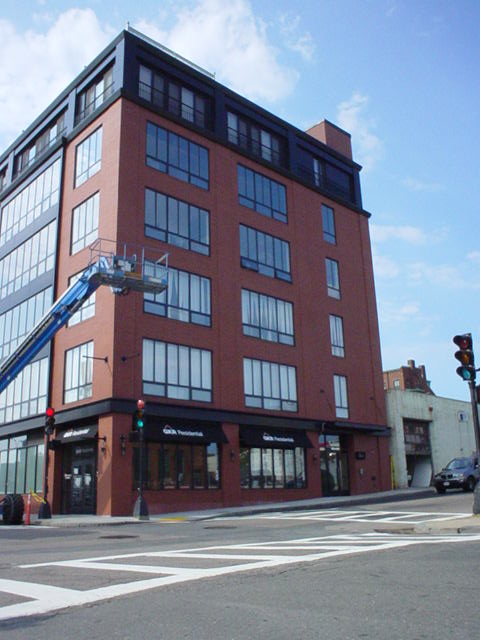
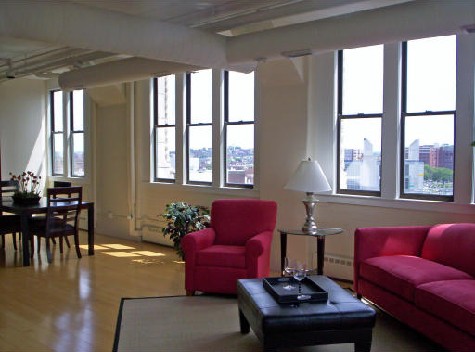
High-end boutique living with some of the finest Italian finishes in a loft-style setting with the most beautiful stained and scored concrete floors on the market, this is the essence of the Lofts at 36 A. We have spent a lot of time at the development over the past several months, and have really enjoyed the building.

The South Boston neighborhood surrounding the Red Line Broadway T-Stop is absolutely exploding with stunning new developments that each have their own individual focus and feel, catering to particular lifestyles and living standards. The 36 A Lofts is a small, 26-unit, boutique development that is targeted towards a discerning condo buyer who appreciates high-end amenities within the living space, but does not need/want a concierge or fitness center.

Ceiling heights are just under 10 feet, and the south wall of each unit is covered in a bank of floor-to-ceiling windows. Located at 36 A Street (Google Map), the newly constructed development stands six stories high. There are two levels of garage parking, one underground (served by a car elevator), and another on the ground floor accompanied by a commercial space (no restaurants). There are five levels of living space, topped off by a huge roof deck, with a common area and private stalls that are either deeded with a unit, or can be purchased separately (only 2 remaining).

HOA fees include master insurance, water, elevator, and maintenance, and are no more than $300 per month in any given unit. Heating and cooling is high-velocity, and the latest in water heating technology is installed in each unit. Over half of the units are sold or are under agreement currently, however, there are still excellent floor plans and units on all levels of the building that remain.

By far, the most outstanding features of the units are the stained and scored concrete floors, the high-end Fisher-Paykel kitchens, and the Italian bathrooms. You can tell that each unit is well-done, with excellent craftsmanship.

The inside story behind the quality at 36 A is that the developer was going to personally live in the building, so he built it to live up to the high standards of himself and his family – given some recent changes in the developer’s family (good things), he will no longer own within the building, but the high-end finishes and craftsmanship have stayed.

We are providing buyer representation for those interested in the Lofts at 36 A, please contact us for more information, to setup a showing, or to provide assistance in writing an offer.

Lofts at 36 A

Lofts at 36 A

Lofts at 36 A

Fire Sale at 210 South Street Lofts

Perhaps the developer thinks that the Labor Day weekend will bring out hungry buyers, as prices for the lofts at 210 South Street were slashed this morning, some units seeing up to $100,000 markdowns. With the return of college students and hordes of families in town this weekend, it might make sense to throw all caution to the wind and hope for the best in selling the last nine units at the new 54-unit concierge Leather District building.

Price per square foot on remaining units hovers at, and below, $500. 210 South Street (Google Map) currently has one-bedroom, two-bathroom units, some of which could facilitate being turned into a two-bedroom by adding a wall (which we can work into an offer for you). Current prices run between $575,000 to $750,000 depending on size and floor level within the building (penthouse units, with the beautiful arched windows, still remain). All units remaining are over 1,000 square feet, with the majority around the 1,300 square foot mark (a single unit remains that is 1,700 square feet).

210 South Street loft condo fees currently run between 40 and 60 cents per square foot, and include heat, water, sewer, master insurance, security, elevator, exterior maintenance, snow removal, exercise room, and extra storage.

Please contact us for more details and to setup a showing.

210 South Street Lofts

Home Financing Mortgage Scams

A few days ago, Michelle Singletary of the Washington Post wrote an op-ed piece entitled “A 400 Percent Return in 7 Days? Riiiight.” After briefly discussing the difference between pyramid promotions – which are illegal – and multilevel marketing schemes – which are not, Singletary moves on to describe a suspicious meeting she recently sat in on.

The speaker was a representative of Financial Independence Group, a multilevel marketing scheme that preys on homeowners. Basically, you have to pay to join, but you have the potential to earn 400 percent of your initial membership fee if you can convince five more people to join…and if two of those five refinance their homes through Financial Independence.

Of course, Singletary did some snooping around, and found out some things that seemed rather suspicious. For instance:

  • Financial Independence claims not to be a mortgage broker, yet they send out applications requiring employment history and other information needed to process a loan.
  • Financial Independence’s application also requires a $425 application fee!
  • Members are encouraged to dunk their home equity into risky investments.
  • Members can also earn “by giving wealth-building presentations.” (Read: by deluding other homeowners.)
  • In order to find out more about membership, you have to become a member.
  • The company has supposedly been in business for 10 years, yet Singletary couldn’t find any record of the company earlier than 2006.
  • Although Financial Independence’s purpose is supposedly to provide financial advice to members, they refused to give Singletary the names and credentials of their financial advisors.
  • In fact, every time Singletary asked for more specific information about the company, her questions were sidestepped or outright refused.

Reading this article, it is obvious how important it is for homebuyers and homeowners to know what to look for in a mortgage broker. As with any business that has the potential for lots of money, scams abound, and it is far too easy to get taken advantage of.

Here are a few ways to protect yourself from dishonest mortgage schemes and services:

  • Always make sure the person you are giving your information to is licensed, whether they are a mortgage broker or a loan originator.
  • Always check all the details of the deal you are being offered. If the mortgage broker sidesteps your question or redirects your attention to how happy the new loan is going to make you, get out fast!
  • Avoid anything with an abnormally high price tag, such as home-buying seminars, membership applications, and financial “advice.”
  • Always check brokers or other businesses out with the Better Business Bureau before committing to anything. Often even a simple Google search can dig up dirt on a shady company.

Whether you are buying a new home or refinancing an old one, doing your homework can help you make sure that you never get “taken” by an unscrupulous mortgage broker!

Thank you to Logan Chierotti, from www.ColoradoHomeHelper.com, for contributing this blog post.

Bryant on Columbus

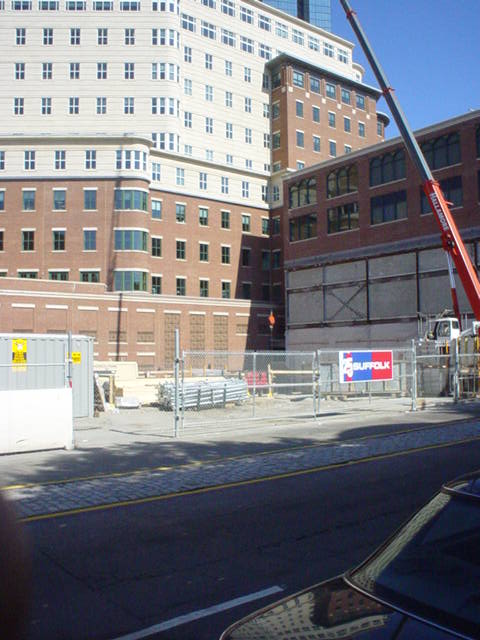
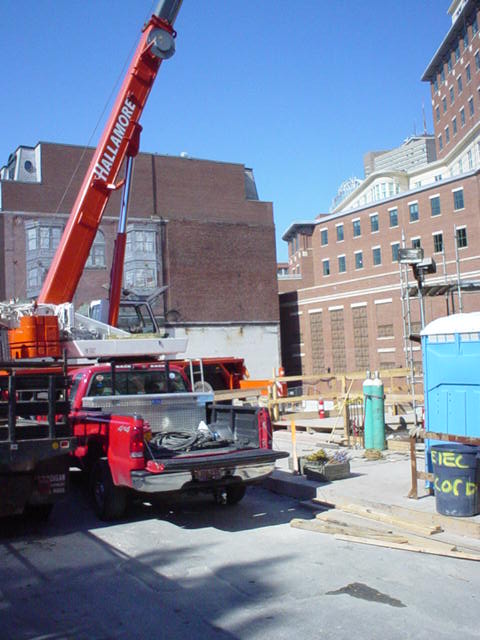
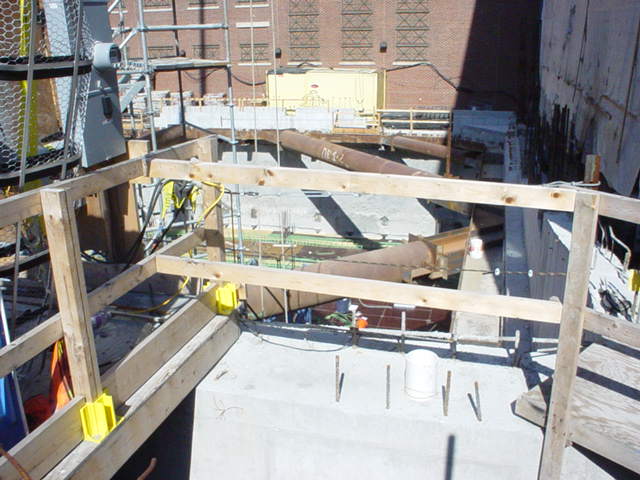
According to inside sources, the Bryant on Columbus at 303 Columbus Avenue (Google Map) on the border of Boston’s Back Bay and the South End has poured its first concrete wall as part of its underground parking garage. According to construction sources, we should begin to see part of the structure rise out of the ground within the next few months. We have the below exclusive construction photos.

The Bryant is scheduled for a June 2008 completion, however, looking at the difference in progress between the Bryant and other similarly scheduled developments (i.e. the Mandarin Oriental, FP3 Boston), the Bryant has to pick up the pace. For preconstruction pricing, or to make a reservation for a unit at any of the above-mentioned condo developments, please contact us.

Bryant on Columbus

Bryant on Columbus

Bryant on Columbus

City Center Condo Prices Buck Trend

In a Wall Street Journal article today entitled ‘Steep Home-Price Drop Stirs Fears’, Kelly Evans finally spent some time covering the concept that all of the press, statistics, and news that continue to hit the market regarding housing prices across the country may not be entirely applicable to city centers such as New York and Boston.

Notably, the S&P/Case-Shiller survey found that prices in the New York City metropolitan area declined, even though most local real-estate agents say prices for expensive condominiums in Manhattan continue to surge. There are two explanations for the difference. First, the S&P/Case-Shiller survey covers only single-family homes, not condominiums and cooperatives, which dominate the Manhattan market. Also, while prices are still rising in parts of the city, they are starting to decline in the suburbs.

Sound familiar? Oddly enough (sarcastically), Boston (proper) is mainly composed of condominiums, and when we speak about housing statistics (at least on this blog), we are speaking about the city center, as opposed to the suburbs (or including the suburbs).

“There’s a divergence between what’s going on with suburban homes and the apartment/condo market in the city center,” said Standard & Poor’s Vice President and index committee member Maureen Maitland.

As we have stated before, it is indeed fair to be somewhat critical of broad market assertions about prices, as the unique circumstances of downtown / city center living, is not often portrayed accurately – even by Boston Globe reporters and others who seem to continue to concentrate on state-level information that does not represent the true story of the Boston condo market.

Boston W Hotel and Condos

For more recent articles on the Boston W Hotel & Condos, click on the Boston W Hotel Condos tag above.  Additionally, now that the sales center is open, contact us for more information about setting up an appointment.

Just when you thought (or rather, you are being fed the message by the popular press) that the housing market is in a downturn, Boston goes and breaks ground on a $200 million development that will change the skyline of the Theater District, and inject true upscale class and style in living accommodations for visitors and residents of Boston.

[Read more…]

The Dumpsters Are Gone

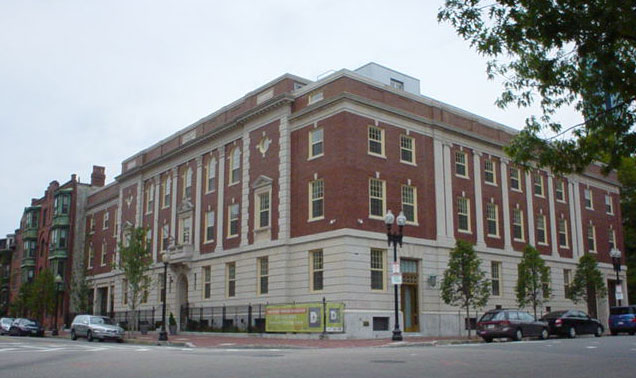
The last of the dumpsters outside the new D4 Condo Development at 7 Warren Avenue in the South End have been removed. Construction has taken one of the landmark properties in the South End, the former D4 Police Station, and converted it into a 26-unit boutique luxury condo development.

D4 Condos

There are currently 8 units remaining at D4 for sale, including 2 and 3 bedroom units, starting at $1 million. For more information, please contact us.

US Condo Downturn Troubles Lenders and Developers

The Wall Street Journal reported this weekend that in cities across the US, namely Miami, instances of foreclosure and condo development bankruptcy are increasing. The problems are emerging as some buyers who signed contracts to by new condos two to three years ago, when construction was just starting, seek ways to back out as they encounter trouble getting financing in the suddenly dicey mortgage market. Falling prices are forcing appraisals down, so banks aren’t willing to lend the full amounts that people committed to in the sale contract.

Boston appears to be bucking that trend slightly, or at least serving up a different flavor of the same end result. Consider that Bostonians continue to lay down large deposits on units in condo developments that are far off on the horizon, with what on the surface, appears to be little to no concern over obtaining financing when the occupancy date approaches, and final checks have to be written (take for instance the Mandarin Oriental, which is practically 100% sold, and will not open until June 2008, as well as 45 Province, which is on track for a 2009 completion, but is experiencing strong sales, and large deposits, thus far).

Where condo developments seem to be experiencing issues in Boston is not so much on the consumer financing end, or consumer demand for that matter, but on construction costs that have increased to levels that do not allow developers to turn a profit on making the project a reality. Take for instance, Columbus Center, which was approved years ago, but has not broken ground due to rising construction costs that erode project profit potential, the Broadluxe that is currently foreclosed upon by TD Banknorth for various construction cost related issues, the original Channel Center effort that saw a whole block purchased by a developer, only to see a small portion of the area developed, or perhaps most recently, the announcement that East Pier (Portside at Pier 1) in East Boston may flounder because developers anticipate not obtaining the profit levels for which they had hoped.

However, a broad brush stroke story on the state of the entire US provides little insight into the local market here in Boston. Despite the four above-mentioned condo development projects experiencing issues, be that temporary or permanent, construction still continues and will continue. Take for example The Clarendon and Russia Wharf (to name only two), both of which have recently broke ground on new construction in the Back Bay and on the Waterfront respectively.

With the little consistency that is seen (or unseen) in even the Boston market, it leads one to question whether the failure of certain condo development projects in the city are simply a result of particular developers seeking to take advantage of the demand from three to four years ago (the time when planing and permitting took place) , and a lack of planning and foresight to build proper safeguards into their projects.